
After a stressful day at school, you crash on the couch and turn on Netflix. Staring back at you is a new true crime series. True crime has been on the rise, from podcasts to award-winning documentaries. Defined as the depiction of real-life criminal cases that include murders, kidnappings and thievery, true crime seeks to bring light to the mystery of unsolved cases. At the heart of true crime, however, is the desire to make money. While it may seem like harmless entertainment, true crime ultimately depends on exploiting and minimizing victims’ suffering and identities.
Aside from Netflix documentaries, the true crime craze has given rise to content creators who base their monetizable platforms on retelling these stories. Creators often use clickbait and humor to increase engagement, coupled with doing makeup or eating food while telling the stories. The effect is clear: it takes away from the victims’ stories and turns them into a cash grab. One example of this is Bailey Sarian, a true crime YouTube creator facing criticism for her series, “Murder, Mystery & Makeup.” Sarian continuously makes jokes while she tells viewers about serious and often violent cases, meaning that her videos can come off as insensitive and even disrespectful to victims. Her delivery takes away from the cruelty of crimes, and she is just one example of this trend.
More often than not, these stories focus on the perpetrator and attempt to psychoanalyze the motives behind the crime. This, however, completely takes away from the victims’ suffering and turns the case into a form of entertainment. Creators should instead respect the victims, because at the end of the day, influencers are making money off of very real people and the events they endured. Jennifer Nguyen (II) explains, “It’s important that the creator must be well educated. […] Content creators should consider the victims’ privacy and use careful vocabulary when retelling these stories. It’s sometimes easy to forget that these stories are very much real.”
Though some might claim true crime is beneficial for public safety and helps tell the stories of lesser-known victims, it nevertheless fails to adequately support the victims. Neither the victims nor their families are often compensated for the publicity of their suffering, but social media creators are able to profit from them. More often than not, victims are not even aware that their stories are being covered at all until their name is blowing up
online. How can true crime help protect the public when it can’t even protect the very victims it shares?
Sensationalizing and dramatizing true crime ultimately desensitizes the public to crimes, trivializing victims’ suffering. Falena Harilall (II) agrees that “if you consume true crime excessively or view it solely as entertainment, then it makes the real suffering and violence seem less serious or even normalizes it.”
Even if the creators are respectful, true crime documentaries and series often prize certain victims above others, meaning that some victims’ trauma is minimized because of their identity. Within the media, there is a tendency toward “missing white woman syndrome,” a phenomenon where attractive, upper-middle class white female victims are more often covered than victims of other backgrounds. In this way, true crime also reflects a broader trend in U.S. history: white women have consistently been seen as innocent victims that must be protected from racist depictions of men of other races. Even though people of color are statistically more often the victims of crimes, since stories about white women get views and likes, algorithms reinforce these biases and other stories are not told.
Sometimes creators choose victims based on the brutality of the crime they experienced, which reduces a victim to one event and disregards the rest of their identity. Kamille Fisher (II) says, “For the victim, [true crime] is a way to gain universal support, but it also has become a huge entertainment industry, where their stories are no longer considered in the moral aspect, but often a surge to find the most gruesome and horrific stories.”
True crime is still contentious in many regards. Creators must ensure they are knowledgeable about the stories they tell and emphasize the victims’ perspectives, not just the motives behind the crime. They might also consider donating proceeds to victims’ families or foundations that support victims of these crimes, rather than simply reaping the rewards themselves. To you, the viewer and listener of true crime podcasts and documentaries: challenge yourself to find a story of another marginalized group of people. Keep an eye out for how the victims are portrayed in the retelling. After all, true crime should be used to help solve crime, rather than sensationalize it.
Categories:
True Crime or True Exploitation?
June 29, 2026
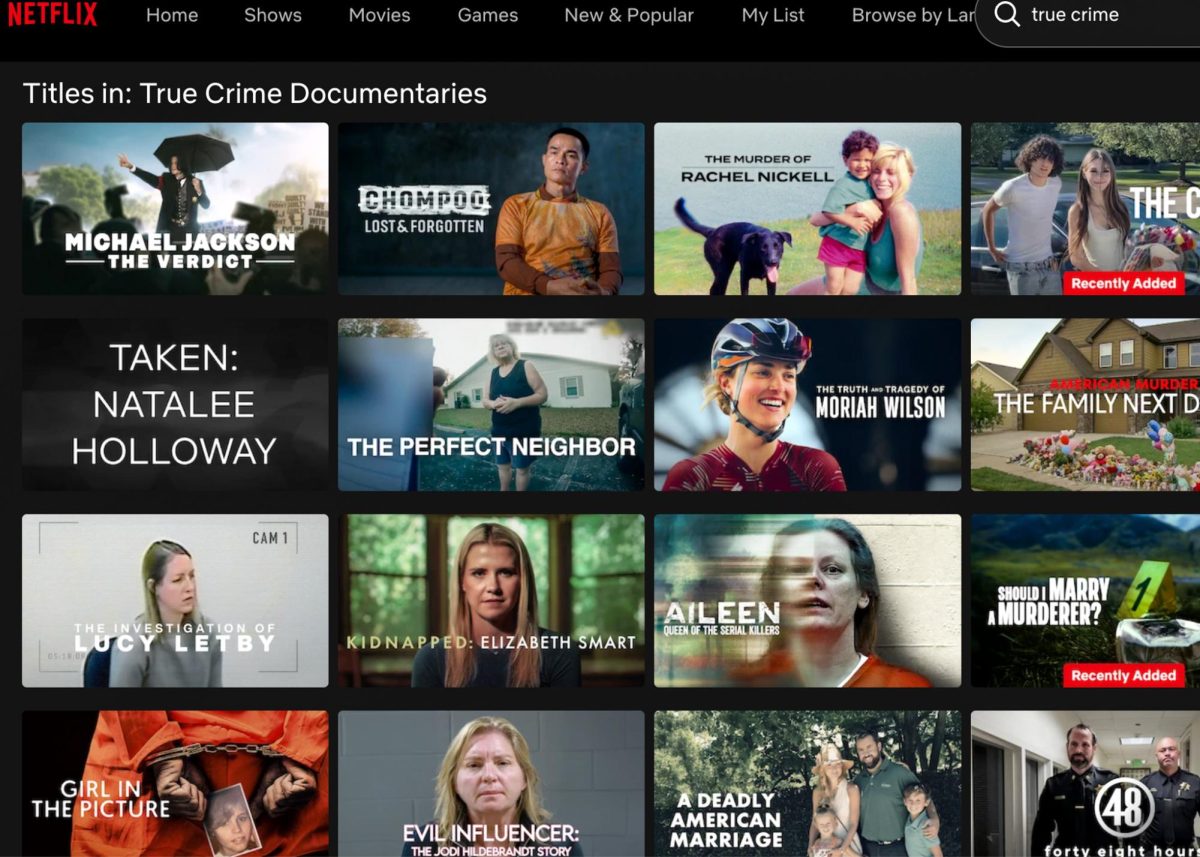
Netflix true crime documentaries are on the rise. (Source: Netflix))
More to Discover