In Mayor’s Office Gallery at Boston City Hall, a new exhibition has appeared. Open on display from February 16 through May 8, Timothy Hyunsoo Lee’s Gwisin Baljaguk (“Ghost Prints”) is a haunting investigation of identity and belonging.
Lee’s work was chosen after he applied to an open call for artists held by the gallery. Boston City Hall has five art galleries that are open to the public as a way to support local creators while also asserting arts and culture as an essential part of the city. Galleries and Exhibitions Manager Mariana Rey, who worked with Lee to curate the exhibit, explains, “We felt strongly about the dialogues his work could spark in our community.”
Born in Seoul, South Korea, Lee came to New York City as an undocumented child. His work reflects his experience of being caught between cultures as a queer immigrant man in the United States. He uses unique lighting in his artwork to give his figures a ghostly effect, which represents feeling invisible. In addition, he often features mugwort, a plant that is revered in Korea, but invasive in the United States. This intentional inclusion inspires conversations about what it feels like to be invasive or to belong.
Time and movement are another critical aspect of Lee’s work. His artist statement notes that his works reflect his “deep anxieties about the aging body, bound by societal constructs and abstract norms,” and “offer, at most, a snapshot of timeless pursuits […] captured by a body constantly in motion.” His art aims to create moments suspended outside of space or time, full of emotion.
Boston City Hall’s art galleries are a way to acknowledge the talented and diverse range of artists who make Boston their canvas. Publicly featuring an artist whose work is so deeply rooted in the immigrant and queer experiences is incredibly important, especially during a time where anti-immigrant and anti-queer sentiments are becoming so pervasive.
Art has always been an important medium for making voices heard and exposing people to new perspectives. Even if people don’t come to see this exhibit, its existence still sends a message. Art is a way of signifying what is important. Boston Latin School Visual Arts teacher Mr. Stephen Harris agrees: “[Art is d]efinitely a vehicle of communication — either it be of personal communication, or you have a larger idea or concept that you’re trying to say to the masses.”
Lee’s art has also been displayed in many significant places around the United States, including at the National YoungArts Foundation Gallery in Miami, the Smithsonian National Portrait Gallery in Washington, D.C. and the Museum of Fine Arts (MFA) here in Boston.
In 2024, Lee worked with the MFA Community Arts Initiative to create “Our Family Portrait,” a piece made up of more than 150 students’ representations of their families. In this way, Lee helped to spread his process and message to a younger generation. His work was also featured in the MFA’s Hallyu! The Korean Wave exhibit in the same year.
The fact that so many significant places around the country are choosing to display works that offer different perspectives in a time of such great polarization is testament to the commitment of many individuals and organizations alike to making the U.S. an accepting place for all. Rey comments, “[A]s an immigrant myself, [this exhibit] is very special to foster space for conversations like this, ones that dignify immigrant stories rendered in such a delicate and masterful way.”
Categories:
Gwisin Baljaguk: ‘Ghost Prints’ of Identity
May 5, 2026
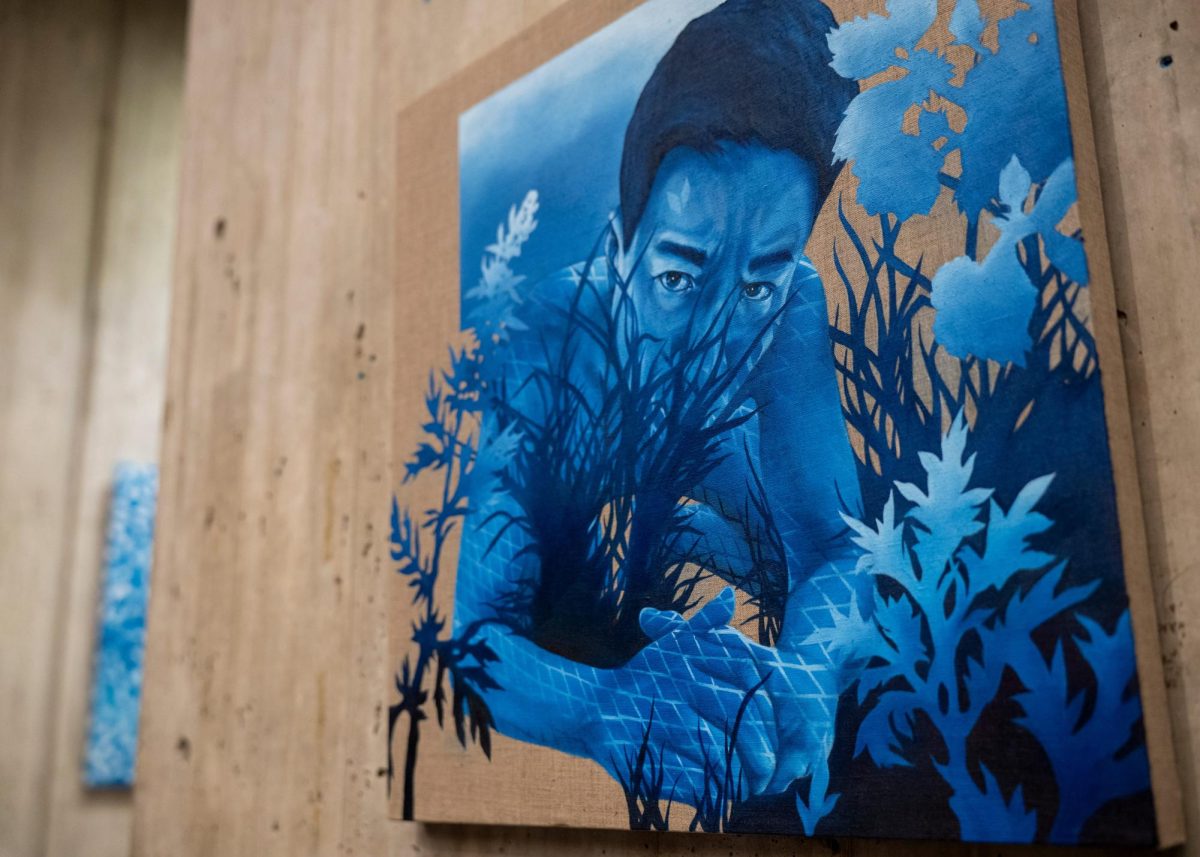
Timothy Hyunsoo Lee’s self-portrait is displayed at Boston City Hall. (Source: Kaiya Platt (IV))
More to Discover