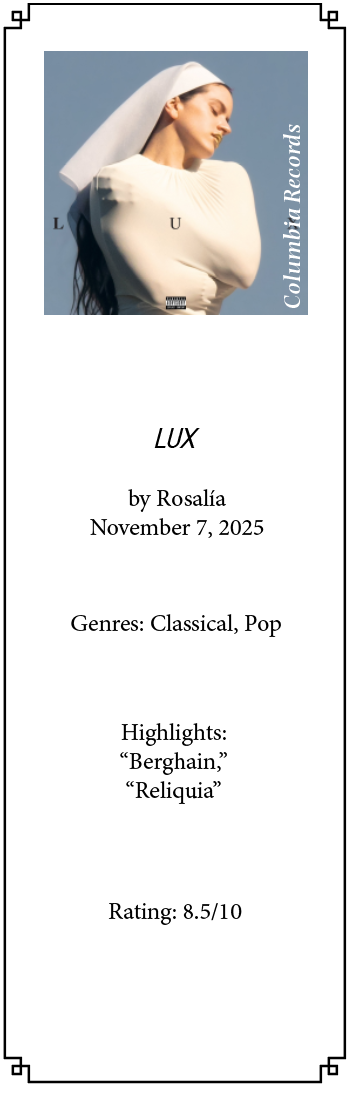
When Rosalía announced the release of her album Lux on November 7, many fans wondered whether the artist, already famous for her reinvention of Latin pop with releases like MotoMami, could produce such a unique album again. The answer, from both critics and everyday listeners, was a definite yes.
Lux is a bold, melting pot of genres spread out over 18 tracks. The album blends elements of pop, flamenco, the avant-garde and, most notably, classical music. Rosalía worked with Daníel Bjarnason, an Icelandic conductor who conducted the London Symphony Orchestra for every song on the album. In an interview with , he describes the album’s production, noting, “I was surprised by how big a part the orchestra played in all of the songs. They were not there as added shine, but they were an integral part.”
Described as a reimagination of pop music, the songs are sung in multiple languages, including Ukrainian, Portuguese and Catalan. Lux is also uniquely divided into four movements, further exemplifying Rosalía’s fearless and artistic vision.
The lead single, “Berghain,” features renowned artists Björk and Yves Tumor, who composed the song “Limerence.” Beyond “Berghain,” the careful collaboration of the three artists is reflected throughout the entire album by evoking a dramatic tone and sense of desire, magnified further by the intense orchestra in the background.
“Berghain” was released before Lux and is still considered one of the most cinematic and daring tracks on the whole album. The song opens with dramatic string arrangements and choral elements from the London Symphony Orchestra, which Lucca Miranda (IV) describes as giving off “a very renaissance, French-y vibe.”
As the track continues, the production gradually builds in intensity, layering electronic beats with the orchestra. Rosalía’s vocals move between restraint and release, while Björk’s unique voice adds a mystical feel that heightens the song’s emotional impact. Yves Tumor’s influence is felt in the song’s darker edges, through distorted synths and unpredictable changes in rhythm.
Lyrically, “Berghain” leans into intense themes of human emotion, such as longing, intimacy and obsession. The themes reflect the song’s namesake: a club in Berlin famous for its unique way of curating the specific vibe within. There is constant tension in the song, which makes it feel both seductive and unsettling. The orchestra is ever prominent throughout the entire track, growing louder and quieter, acting as a partner to the vocals. “Berghain” sets a tone of boldness for the rest of Lux and shows Rosalía’s willingness to take creative risks.
The second track, entitled “Reliquia,” is a heartfelt, vulnerable effort. Rosalía puts herself forward, explaining her own feelings about sympathy and the importance of leaving behind a part of herself once she is gone. The song is a tribute not only to her vulnerability about her internal struggles but also to her ability to triumph over those very same hurdles.
Rosalía is no stranger to speaking about her own obstacles. According to long-time listener Javier Gonzalez (IV), however, this release was different: “The song felt more powerful and strong[er] compared to the rest of the album. The song encapsulates what this whole album felt like.”
“Reliquia” is one of Rosalía’s most triumphant and fervent efforts to date. Throughout the track, Rosalía expresses her desire for a “relic” and to be remembered after she’s gone. After this performance, however, it is clear that a part of her life will stay with everyone who has been inspired by her words.
“Mio Cristo Piange Diamanti” stands out on Lux as one of the album’s most spiritual tracks. The song feels intimate from the opening moments, blending minimalist production with soft, echoing vocals. “Mio Cristo Piange Diamanti” means “My Christ Cries Diamonds” in Italian, evoking a sense of beauty through pain. The track explores themes of devotion and emotional endurance.
Rather than building toward a dramatic climax like “Berghain,” the track remains restrained, allowing silence and space to carry weight and emotion. There are subtle guitar lines and faint sounds of the chorus drift in and out, creating a fleeting sense of serenity. Rosalía’s voice sounds almost prayer-like, making the song feel more like a confession. “Mio Cristo Piange Diamanti” slows the album down, offering a reflective pause that deepens Lux’s emotional impact.
Rosalía sings in a multitude of languages throughout the record. Even if you cannot understand fully, the music itself does just as much speaking.