This June, the Boston Latin School Speech and Debate team (BLSS&D) will send two qualifiers, Ikra Abbasi (II) and David Wang (III), to the National Speech and Debate Tournament in Richmond, Virginia, where they will compete for the opportunity to be recognized nationally in their respective events.
The National Speech and Debate Tournament is organized by the National Speech and Debate Association (NSDA) and is one of the most prestigious tournaments that high school students can attend.
There are many different events within speech and debate, including Public Forum, Congress, Dramatic Interpretation and Lincoln-Douglas. Each event focuses on a different topic, such as public policy or philosophy, and there are also differences in the format of each event. Congressional Debate, for example, is an event where a group of students debate legislation in the manner of the United States’ Congress, while Dramatic Interpretation is an event where students perform excerpts from published literature. In Public Forum, students speak in alternating speeches, arguing, refuting and weighing arguments.
To qualify for NSDA nationals, students need to place well at either their district tournament or the official Last Chance Qualifier. BLSS&D team members note that some districts and events may have weaker or stronger competition, so there are disadvantages and advantages depending on which district a student is a part of or what event they pursue.
There are many factors that contribute to students’ success. Qualifiers often demonstrate the importance of confidence. They learn that it is most important to speak with composure, even when the issue is unclear.
In addition, qualifying for NSDA nationals requires a lot of practice and preparation outside school. Jerry Li (II), who qualified in Public Forum at the Tournament of Champions competition, comments, “We’ve constantly spent around two to three hours each day on debate, including practicing and preparing evidence. We do things like practice rounds, redo speeches, speaking drills and reading endless articles to prepare evidence.”
The students’ success was not an individual effort. Throughout the year, students received support from their fellow teammates, club advisors and coaches.
Abbasi, an NSDA qualifier in Congressional Debate, explains, “I think that the team, in general, cheers everybody on so well. I’ve had some bad tournaments, but […] I’ve had people pick me up from the ground.”
Teamwork is especially important for events that involve multiple students working together, such as Public Forum and Policy. Li and his partner Sam Parsi (II), for example, turned their differences into strengths when arguing. It was because their interests were different that they were able to become stronger by covering for each other.
The main goal for the future of the debate team is to prioritize getting more coaches to help new and younger students on the team. Because the team is largely student-led, however, captains plan to continue helping to prepare every student on the team by running drills and practice rounds regularly.
The BLSS&D team is excited for the students attending NSDA nationals later this month. Mr. Yilmaz Yoruk, BLSS&D advisor, concludes, “They’ve been working throughout the year, showing up to practice every Tuesday and putting in all the extra hours outside. And then just seeing [how] that results in success for them [is] just very satisfying.”
Categories:
BLS Debate Qualifies for Nationals
June 27, 2026
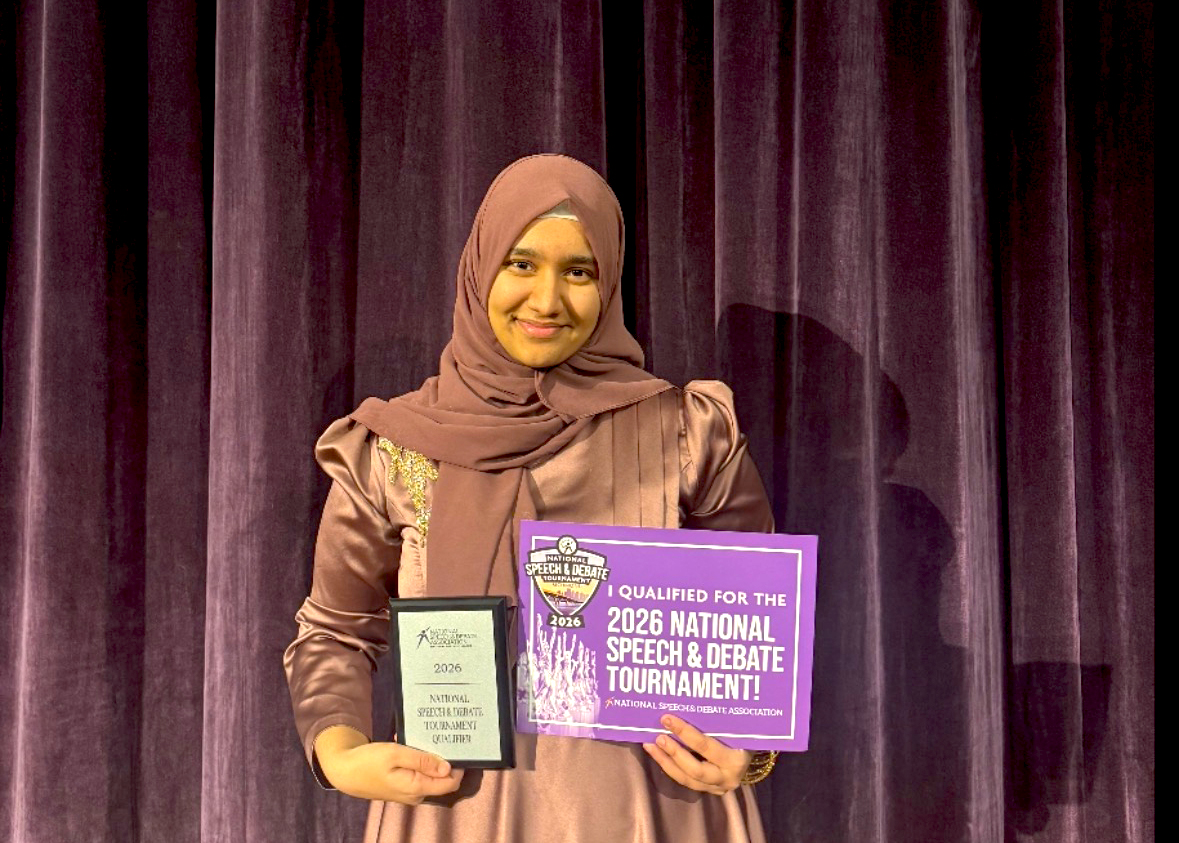
Ikra Abbasi (II) qualifies for debate nationals. (Source: Mr. Yilmaz Yoruk)
More to Discover