Tensions in the Middle East escalated on February 28, when the United States and Israel launched missiles targeting Iranian leadership.
The attacks reportedly killed several high ranking officials, including Iran’s Supreme Leader Ali Khamenei. During the attacks, some civilian areas including the Shajareh Tayyebeh girls’ elementary school were also affected, contributing to rising tensions.
The strikes follow concerns about Iran’s missile capabilities and nuclear program reaching the U.S. Last June, President Donald J. Trump authorized multiple strikes on Iranian military bases, claiming that the threat had been neutralized.
In response to the attacks, Iran responded with strikes on U.S. military bases, Israel and nearby countries such as Qatar. As the situation escalated, Iran closed the Strait of Hormuz, a major oil trade chokepoint that is responsible for shipping one-fifth of the world’s natural gas and oil. Following the closure, commercial vessels have been attacked or seized, and maritime traffic through the strait decreased by over an estimated 90 percent in March.
President Trump announced a ceasefire between the U.S., Israel and Iran on the night of April 8, after stating that “a whole civilization will die tonight” if Iran didn’t meet his deadline to open the Strait. It is unclear at this time whether the two-week ceasefire will hold, especially after continued attacks by Israel against Hezbollah in Lebanon and Iran’s continued closure of the Strait. At the time of this writing, peace talks have failed between the US-Iran and the US is implementing a blockade in the Strait.
Although these events have largely taken place in the Middle East, their impacts have been global. Lucy Zhang (I) noticed the impacts of the war on Boston Latin School students and faculty: “The war has postponed [the Vietnam] trip, and their flights [are] getting delayed and cancelled, so there is a lot of uncertainty that has caused a lot of stress on top of school work and also [what] to plan ahead on what they’re doing.”
The global economy has been impacted greatly, as the Strait of Hormuz is a key location with a significant amount of oil going through that area. This is especially noticeable as global oil prices have risen to over 110 dollars per barrel. In Massachusetts, regular gas prices have risen on average to over four dollars per gallon.
The S&P 500, a stock market index which tracks the top 500 companies in the stock exchange, has not been performing well, as many investors have been deciding whether to pull out their money. The market itself dropped around six percent on April 3, marking the stock market’s worst day since the COVID-19 pandemic. It has rebounded somewhat after the President’s announcement of a ceasefire.
BLS AP Economics teacher Mr. Patrick Boor explains, “With a market for one good, [as] the input gets more expensive, supply decreases. Well, imagine with oil, […] they’re part of inputs for a lot of things. […] If there’s a huge supply shock to an oil input, the curve decreases or shifts to the left, and what you notice is that price levels are now higher, which represents the inflation.”
The end of this war is unclear as of now. People, however, are expected to brace for a rough economy, as it will still be affected regardless of whether the war ends or not.
Mr. Dominic Rinaldi, a BLS AP U.S. History teacher, concludes, “[If] the war ends soon, prices [will be] high and will remain high because of the disruptions done; plus, businesses will use it as an excuse to keep prices high to continue to profit. [If] the war keeps going, everything that depends upon oil, which is everything, will hurt. It could be devastating for the global economy and will funnel money, quickly and immensely, into the hands of the wealthiest people in the world.”
Categories:
Updates on the Iran War
May 5, 2026
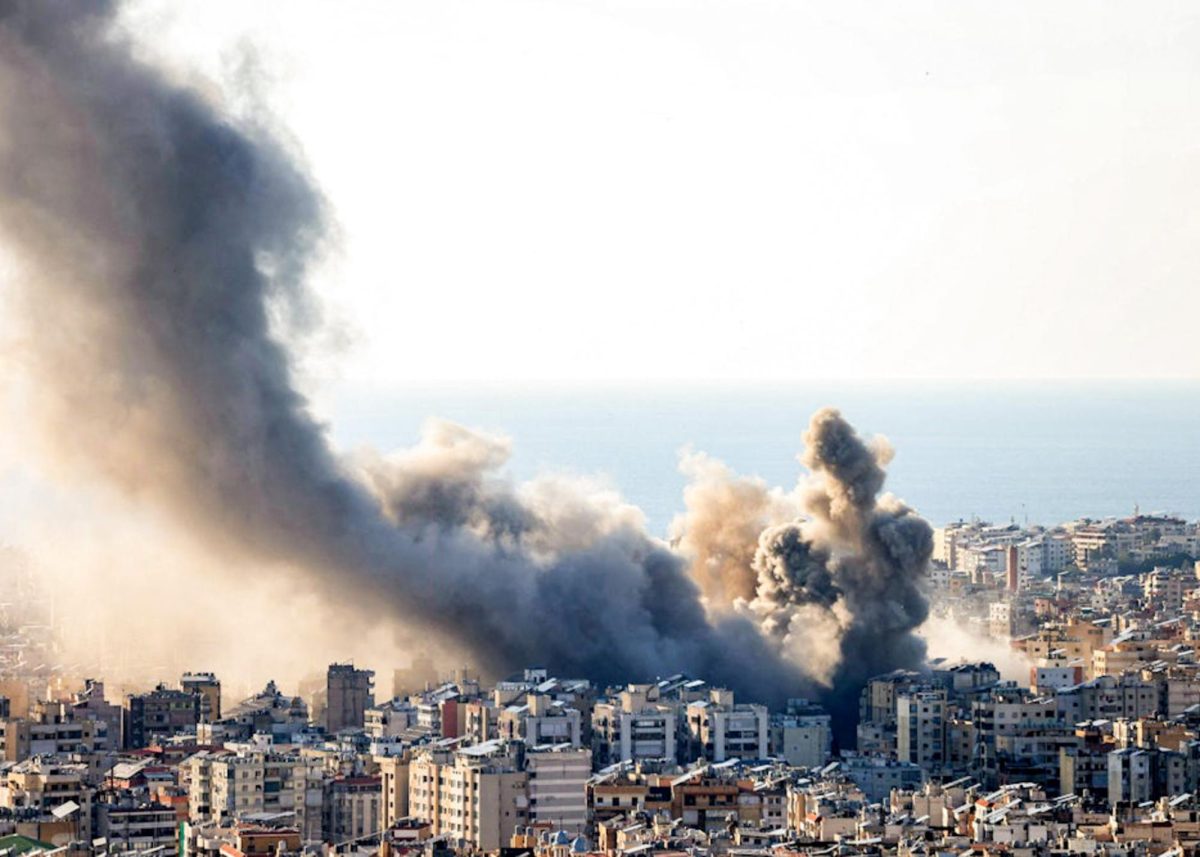
The United States launches airstrikes in Iran. (Source: AFP)
More to Discover