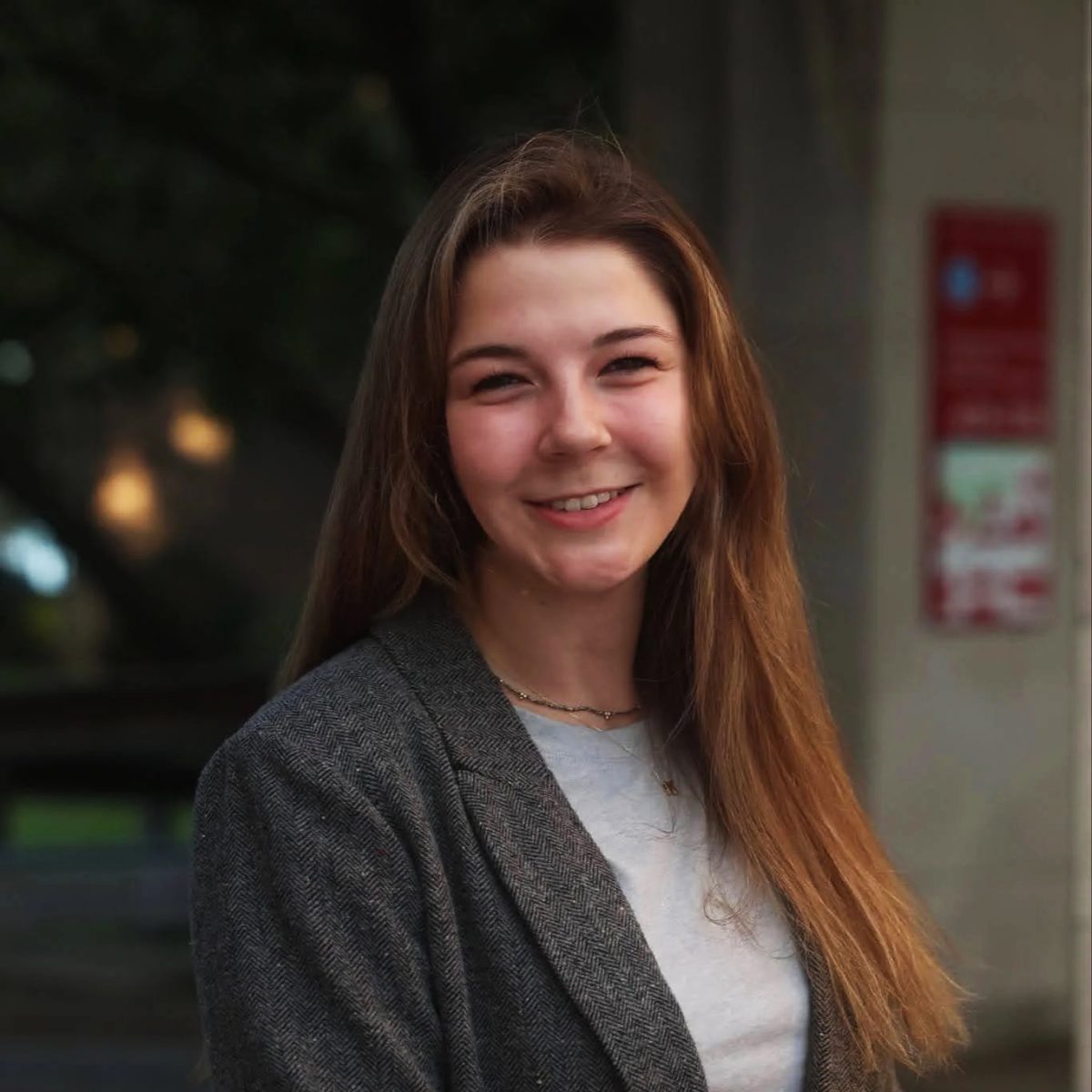
Katie Rouse ‘22 is a senior at Boston University (BU), where she is involved in student journalism. During her time at Boston Latin School, she served as Head News Editor of the Argo.
What is your favorite memory while working with the Argo?
My favorite fun memory is being in the computer labs when we’re doing Copy and Layout for hours. Being there until 6:00 P.M. or 7:00 P.M. at night [and] getting the Insomnia [cookies] delivery was just pretty fun. It’s fun to be with the team when you guys are all working on the same thing; you’re all tired and want to go home, but you’re still there together. Those were some fun memories. But to give you a more serious answer, I [also] really enjoyed interviewing people when I was a writer. Editing is fun. I like it a lot because you get to help other people be better writers. But when I was a writer myself, it was just really cool to talk to people and hear from them firsthand about the kind of events that were going on that they were passionate about. I remember one was about, there was this woman who was a refugee from China, where she was doing an event about the Uyghur Muslims and the mistreatment that they were facing. Getting to talk to her and hear her perspective firsthand, and then translate that into an article that I could share with the school community was pretty cool.
Why did you initially want to join the Argo?
I saw the Argo around school, and I like to write. My friend and I, [whom] I just went on a trip with last week, joined [the News section] together. We stayed [there] the whole way through our BLS career.
How did your time in the Argo shape your interest in journalism?
I think it was just fun. The group of people that we had there was pretty incredible, so that was awesome. Then, to have such a formal, put-together, impressively run newspaper that was managed almost entirely by high school students — I didn’t realize how rare that was until I got to college. I think the Argo and BLS, in particular, as a whole, they just taught me to be a very meticulous, purposeful writer, and they made me a much better writer. I developed a love for it. […] The Argo was where that passion was initially kind of sparked. So that’s been pretty cool to trace the thread through the years.
How are you involved in journalism right now at Boston University?
When I got [in]to college, I joined the Boston University[‘s] International Relations Review (IRR). I’m an International Relations major. BU[’s] IRR [is] a magazine that we have on campus that allows students to write on underrepresented topics in foreign affairs. So as a freshman going in, I knew that I had really enjoyed my time with the Argo. I love writing, particularly in media, as opposed to just academic writing, so it was an opportunity that I wanted to get involved with. I interviewed before I even got to campus as a freshman over the summer, and then got the position and started writing. I was a writer for my first two semesters. So I published two articles to the Library of Congress, and then the following year, I became the senior editor for the Europe section, which is what I have been writing for. And then I did that for two years, and then just this year, I quit entirely. So I’m actually not involved with any formal writing right now, but I’m about to start a new internship where I’ll be putting together a daily newsletter about space and national security developments.
Were there any big surprises or challenges when you entered BU’s IRR?
I would say the challenge was mainly adapting to a different, higher level style of writing [than] the Argo — [than] News in particular, which is the only section that I ever wrote for. Then, going from that sort of writing and much shorter pieces to the type of writing I was doing for the IRR, which are 2,500 plus word articles that are a lot more academic and in depth. You’re talking about a development, and then you’re [also] putting your own spin on it, analyzing it, explaining how this impacts other countries around the world, how it impacts the U.S., what it means for the country that it’s happening [in and] whatever [else] you choose [to do]. Adjusting to that style of writing, trying to get around my bias — [thinking] I’m only going to present the facts and I’m going to let the audience decide — [and] helping myself understand that it’s okay to take a position and I need to be able to defend it [were challenging for me]. […] That was sort of an interesting hurdle for me, [and] honestly, I’m still struggling with [them].
What advice would you give to a high school student interested in journalism?
I would say: take advantage of every opportunity to write that you do have. If you’re someone who is dedicated to journalism, find those opportunities wherever you can. Because I guarantee you, for example, my college, we have over 25 student publications. Even if it’s not exactly what you want to do, if you have an opportunity to write, take it, because it will only bolster your skills, make you a better writer [and] give you better feedback to then use in the future. When you’re at that dream position, you want to make sure that you’re prepared for that. Then, I [also] think reading is a big part of making you a better writer. Reading for fun, reading academically […] are super important. I found that reading, even when, you know, you get busy and it’s hard and boring and you don’t want to do it, it still makes you a much better writer, and it pays off a lot in the end.
Would you like to share any final thoughts about your experience with the Argo?
I would just say [that] the Argo is a unique paper, and they’re unique at what they do in the quality and the performance of the product that they put forward. I haven’t been [in BLS] for four years, but when I was there, at least, it seemed so normal [for everything to be this way] because that’s the standard. However, once you leave that bubble, it really just opened my eyes to how much of a learning opportunity the Argo was. [It] is beyond anything that my friends had at similar schools, and that is something that I’m so grateful for now, even if I didn’t necessarily appreciate it because I didn’t know when I was there at the moment. Knowing how fantastic of an opportunity the Argo is and taking advantage of it while you have it is already a huge step in the right direction if you’re looking to go into a career in journalism.