On October 28, Boston Mayor Michelle Wu delivered the first annual State of the Schools address at the Josiah Quincy Upper School (JQUS) in Chinatown.
Wu was joined by Superintendent of Boston Public Schools Mary Skipper and Chair of The Boston School Committee Jerri Robinson. All three set the lofty goal of making BPS the best school district in the country while acknowledging that there is still progress to be made, though Wu did not elaborate on what the district would do to achieve this goal. Throughout her speech, Wu discussed the district’s successes over the last few years under what she called the “stability” of Skipper’s leadership.
The program began with a short video featuring educators praising BPS’s policy initiatives and what Wu termed “heavy lifting,” or students taking initiative in lessons by doing things such as solving math problems together or working on shared projects.
After a short break, the JQUS Heads of School Richard Chang and Stephen Cirasuolo along with a student named Omar welcomed the crowd to the school. They were followed by Robinson, who endorsed Skipper’s leadership while praising the educators in the room.
Robinson then introduced Skipper, who took somewhat of a victory lap on her progress as a leader thus far, noting that she has been superintendent for around three and a half years now, longer than her five most recent predecessors.
Skipper explains, “We are definitely starting to see the acceleration that we are looking for. I think the mayor and I are very honed in on driving our academics as high as possible.”
As a show of appreciation, Skipper asked specific groups to rise, including educators and business leaders. Notably, nearly the whole room stood when it came to BPS staff, but only a handful of non-BPS affiliated spectators stood when prompted.
Skipper finally introduced the mayor, who took time to acknowledge the prior speakers and mention the new facilities at the JQUS, equating the stars on the auditorium ceiling with higher student expectations.
Even with Wu reciting a litany of successes over the past three years — including air conditioning installations, math tutoring expansion and fifth quarter learning peaks — she says that “we’re not yet where we need to be.”
Mayor Wu did not elaborate on what she was referring to by this statement, but it is most likely related to some of the struggles the district has faced recently, including underperforming Massachusetts Comprehensive Assessment System (MCAS) scores and school consolidation battles that have caused community backlash.
The recent exam school policy change was also excluded in the speech, which ended the practice of granting additional bonus points to students who went to schools with higher than average poverty levels. The change came amid criticism that the district was locking out students who had perfect composite scores while giving seats to others who lacked comparable academic statistics.
As for the district’s new policies around “heavy lifting,” Wu says that “even with AP classes, […] that material is still expected to be [taught] in a different, more hands-on experience than just lecturing.”
When asked how the district would implement this, Wu explains that the district is divided into regions with support infrastructure overseen by Deputy Superintendents. These staff members come together periodically to share feedback and identify classrooms that need support.
This renewed focus on increasing student expectations comes amid MCAS scores that show a majority of students in the district are underperforming in key subjects. According to data from the Massachusetts Department of Elementary and Secondary Education, only 29 percent of BPS students are meeting or exceeding expectations in grades three through eight, compared to the 42 percent statewide.
Head of School Jason Gallagher explains his perspective on the new expectation policy: “I think it would really be hard for the district to do the ‘heavy lift’ policy. I think a better way to frame that would be when we go into classrooms to see students actively learning.”
Wu also mentioned a push for new partnerships with community businesses, which the mayor referred to as “anchor institutions,” and directed BPS to connect students with these organizations for opportunities such as summer internships and afterschool programs.
Despite current challenges, Wu affirms, “We are the oldest public school system in the nation. And, together, it’s time that we make it the best.”
Categories:
Mayor Delivers First State of the Schools Address
December 21, 2025
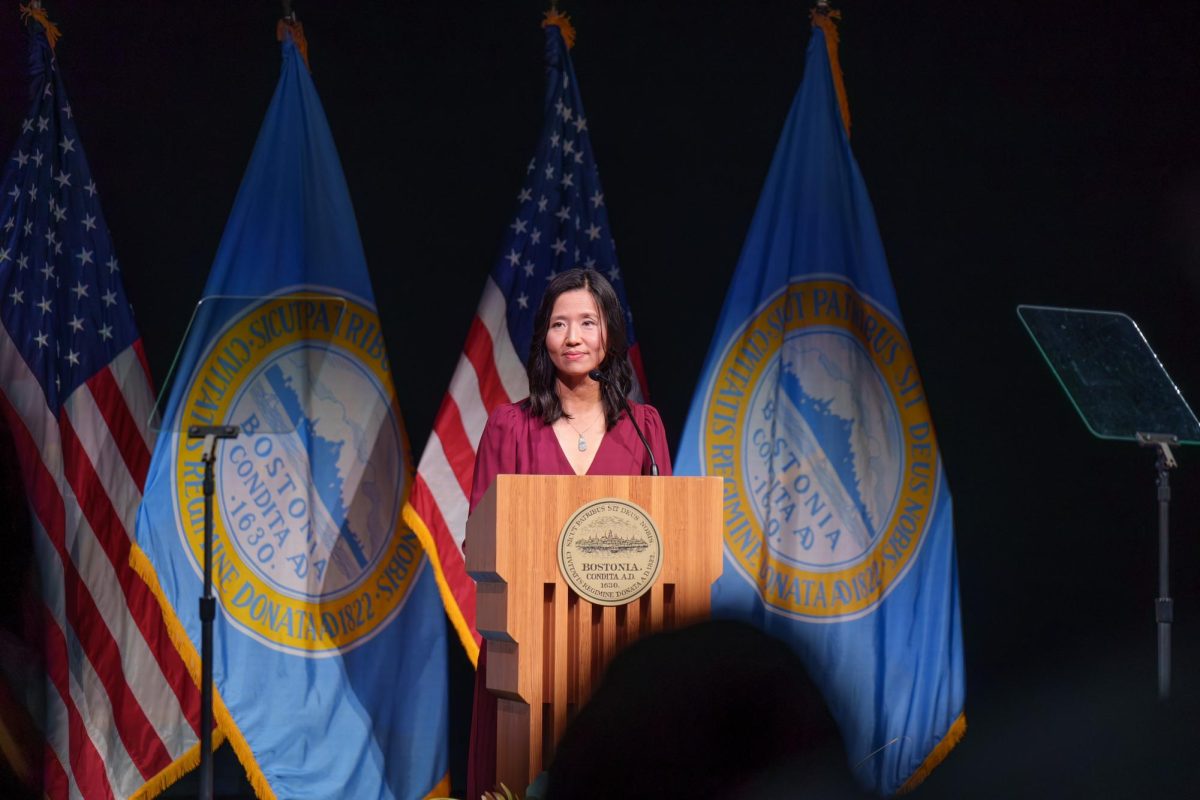
Mayor Michelle Wu receives a standing ovation. (Source: Alex Le (I))
More to Discover